


126
EconoScope | Why China remains central to global chains of industries despite tariffs_我的网站

一 | (ECNS) -- More than a year after the United States imposed reciprocal tariffs on Chinese goods, many multinational companies that shifted production to Southeast Asia are moving parts of their supply chains back to China, underscoring the country's enduring manufacturing advantages. A report by The New York Times cited Alliance Consumer Group (ACG), a Texas‑based flashlight maker, which invested heavily in factories in Thailand and Vietnam after the 2025 tariff hikes. The company found China's manufacturing ecosystem difficult to replace, with flashlights from Chinese producers sometimes priced lower than ACG's shipping costs from Southeast Asia. ACG COO Phil Laster said the experience highlights a broader challenge: while production can be relocated, China's integrated industrial ecosystem remains difficult to replicate. China's strengths include its comprehensive supply chain, world‑class infrastructure and efficient logistics. In Xidian Town, Zhejiang Province, about 60% of the world's flashlights are produced, supported by nearby Ningbo‑Zhoushan Port. China is also the only country with all industrial categories listed in the UN system, leading production in more than 220 of over 500 major industrial products. Infrastructure plays a critical role. According to data from the Ministry of Transport of China, the country hosts eight of the world's top 10 busiest ports by cargo throughput, supported by China‑Europe freight trains and multimodal transport. ACG found costs 12% to 15% higher leaving Southeast Asian ports compared with China, due to weaker supply chains and logistics. China's efficient business environment has also drawn praise. In June, the Sino-Saudi Gulei Ethylene Complex Project in Fujian Province, a large single ethylene production facility by capacity, completed a major construction milestone. Faisal Al-Faqeer, Chief Executive Officer of Saudi Basic Industries Corporation (SABIC), lauded streamlined approvals and project management during construction of the Sino‑Saudi Gulei Ethylene Complex. Stable electricity supply further strengthens competitiveness, especially as fuel shortages in Southeast Asia have pressured factories. Investment data reflects the trend. In 2025, newly established foreign‑invested enterprises in China rose 19.1% year‑on‑year. In the first half of 2026, nearly 4,800 foreign‑invested companies expanded investment. For multinationals, while production can shift, China's integrated ecosystem — combining complete industrial chains, infrastructure and logistics — remains unmatched. (By Gong Weiwei) 
 。
。 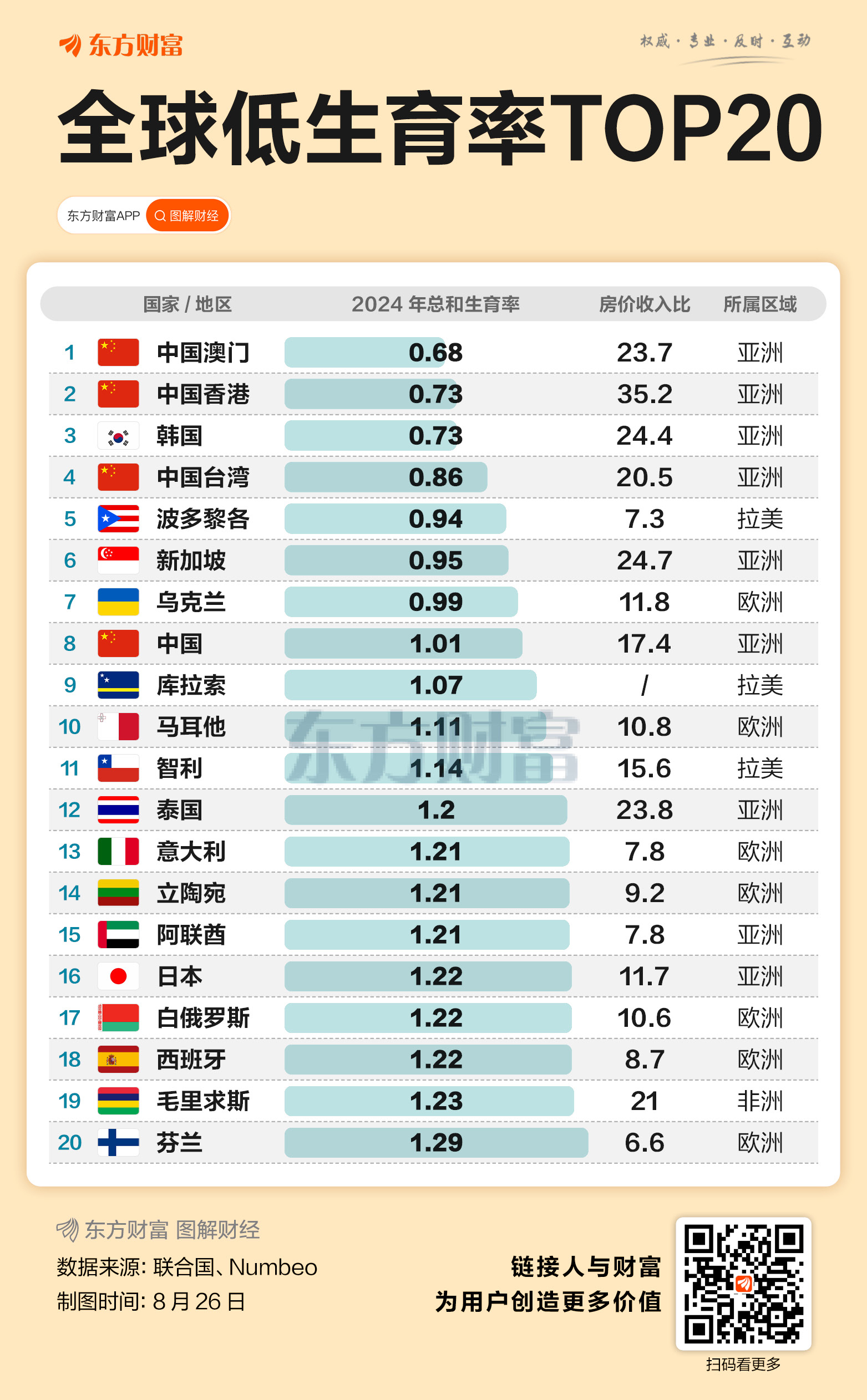 低生育率已经成为全球多地面临的核心难题。近日,新加坡总理兼财政部长黄循财宣布了新的“SG养儿育女配套”,包括增加在职家长的育儿假,以及让每个新加坡公民从出生至17岁获得近7万新元(约37万元)的政府财务补助。 具体补贴方案包括:孩子出生后12个月内发放1万新元,儿童教育账户初始津贴5000新元、家长在儿童教育账户储蓄可获最高5000新元;1—16岁期间每年2000新元;满17岁时教育账户可获1万新元。叠加原有的两项政府补贴约7500新元,全部育儿补贴福利合计口径约6.95万新元。

二 | 不断上涨的房价给年轻家庭带来压力,使得新加坡结婚和生育的难度进一步提升。新加坡移民与关卡局公布的数据显示,2025年新加坡出生人口为29864人,同比减少11.4%,自建国以来首次跌破3万大关。总和生育率从上一年的0.95进一步跌至该年的0.87,已属于全球最低行列。

三 | 总和生育率是衡量人口生育水平的核心指标,指假设一批妇女按当前年龄别生育率度过整个育龄期且无一死亡,每人平均生育的子女数。国际上以2.1为“世代更替水平”,即平均每对夫妇需生育2.1个孩子才能维持人口总量稳定;1.5左右则被视为“高度敏感警戒线”,一旦跌破便有跌入“低生育率陷阱”的可能。 新加坡的困境并非孤例,环顾全球生育率最低的一批经济体,高房价几乎是共同底色。据Numbeo2026年中数据,新加坡房价收入比达24.7,即个人不吃不喝近25年才能买下一套90平方米公寓;中国香港高达35.2、韩国 24.4、泰国23.8,中国澳门23.7。住房成本像一道无形的门槛,将婚育计划一再推迟。

四 | 不过,房价也并非是压制生育意愿的唯一变量。低生育率经济体的共性困境还包括:教育投入的“军备竞赛”使育儿边际成本飙升;长工时与轮班制度侵蚀家庭时间;托育服务供给不足,双职工家庭“生得起、没人带”;“养儿防老”观念弱化,生育的工具性价值下降等多重因素。 由此观之,新加坡近7万新元的育儿配套,方向自然是值得肯定,但现金补贴能否对冲住房、教育、职场等多重压力,仍有待观察。国际经验表明,生育率一旦跌破1.5,单一政策工具往往收效甚微,唯有在住房、托育、教育、工作方式等多方面的系统性改革协同发力,才有可能走出“低生育率陷阱”。 (文章来源:东方财富研究中心)。
Current article:http://rucrhxo.dingruorenhongqiaminmeipeiliu.cyou/news/20260826_206.html
Published on:00:38:45